Technical demo: Bibliotheca
A downloadable game for Windows and Linux
Bibliotheca is exclusively compatible with Love2D 12.0, and will not run on prior versions. Download official Love2D 12.0 builds from the Love2D github:
You need to be logged in to a Github account to use either of these links. The Love2D project does not provide alternative download links for 12.0.
Unmodified copies of these downloads are also uploaded on the project itch.io page for people who do not wish to log in to Github to download Love2D.
System requirements
Operating Systems
- Windows (x86-64)
- Linux (x86-64)
macOS is not supported due to missing OpenGL 4.3 support. All other Operating Systems and CPU architectures not listed above are not supported.
Graphics unit
OpenGL 4.3 support is mandatory
AI use prohibited
AI was not used at any point for any aspect of the development of Bibliotheca.
Images, music, art, assets
All game assets (including all voxel cube face textures) were made by the below credited contributors, and were made during the jam period, with two exceptions:

- Font: terminus-font
- Font: Uncial Antiqua
Team/Credits
| fnicon | game programmer |
| purist | 3D engine programmer, 3D rigger/animator/unwrapper |
| Shiroiii | game director, legendary composer, sound engineer, texture artist |
| Lynod | lore/world builder, screenplay, storyboarder, voice acting coordinator |
| RedSG | 3D character modeler/animator |
| Pixel Jamp | art |
| (uncredited by request) | character concept/reference artist, 3D character modeler |
Note: Some of the credited work does not appear in the game demo release, but is scheduled for the next/full Bibliotheca release.
Technical Commentary
Note that all code is written for the undocumented Love2D version 12.0 APIs. Generally, as often as practical, all code is explicitly incompatible with 11.5 and lower.
Custom pixel and vertex shaders
| commit | love-demo @ 0a423f85 |
The general strategy is to replace Love2D's default (and highly
restrictive) TransformProjectionMatrix with an arbitrary
transformation matrix, to allow arbitrary three-dimensional rotations and
perspective projection.
Three-dimensional vertex attributes are specified via the Love2D
12.0 love.graphics.newMesh API, using an overload not implemented
in 11.5 (nor documented in the Love2D wiki).
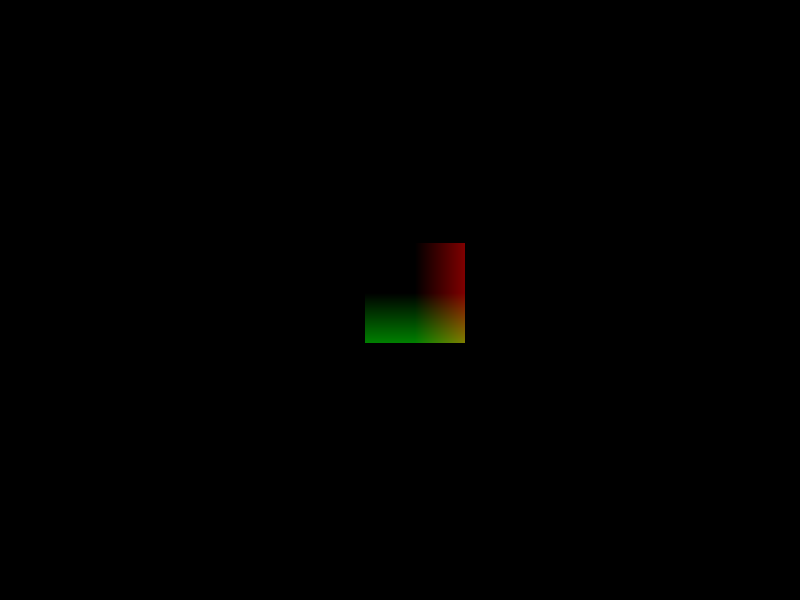
0a423f85
produces the following (admittedly superficially unexciting) image:
3D meshes and 3D rotation matrices
| commit | love-demo @ 0a423f85..955a3e09 |
At the end of this commit sequence, I generated binary vertex attribute data
containing position, normal, and texture coordinates in
the position_normal_texture.vtx file. This is deliberately in
precisely the form that is convenient for direct upload to graphics unit video
ram.
The (Love2D 12.0) vertex attribute declaration is also updated to account for the additional vertex attributes, and I hastily wrote functions to produce projection, view and rotation matrices.
955a3e09
produces the following image:
Matrix/vector math
| commit | love-demo @ 955a3e09..64d959ed |
Love2D doesn't include any math libraries that can operate on three-dimensional vectors, nor on homogenous matrices (at least not in a useful way). I did see that there are a few Lua "vector math" libraries, but I decided all existing options either either did not include enough of the operations I needed, or ostensibly contained roughly correct range of features, but are in fact secretly an exercise in overly-fancy Lua metaprogramming more than anything else.
I instead decided to write my own Lua matrix/vector math library--it is not the first time I have done such a thing.
I initially had an "amazing idea" to store the matrix and vector data
directly in Love2D ByteData
objects, the thinking being that there are (in fact) fewer intermediate
transformations that occur when the matrices are passed to the shader via the
Love2D Shader:send() API.
However, I later, some time after these commits, discovered that this
ByteData idea is roughly ~700x slower
than storing matrix/vector data in luajit C structs.
In the same commit series, I also started uploading and drawing textures via
the new/undocumented Love2D 12.0 love.graphics.newTexture API.
64d959ed
produces the following image:
Collada scene representation
| commit | love-demo @ 64d959ed..bef01af5 |
Collada is a quite well-designed (and sadly abandoned) file format for generalized description of three-dimensional scenes.
This code is mostly a 1-to-1 translation of the original version I wrote in C++ to Lua, though with a few minor improvements I spontaneously inserted during translation with the power of hindsight.
The general pattern is that a Collada (.dae) file (as exported from a 3D modeling tool) is preprocessed by a python script to a form that is easier to use in a real-time rendering context. Specifically, the scene metadata in scene/test/test.lua was not hand-written, but was instead generated by collada/main.py.
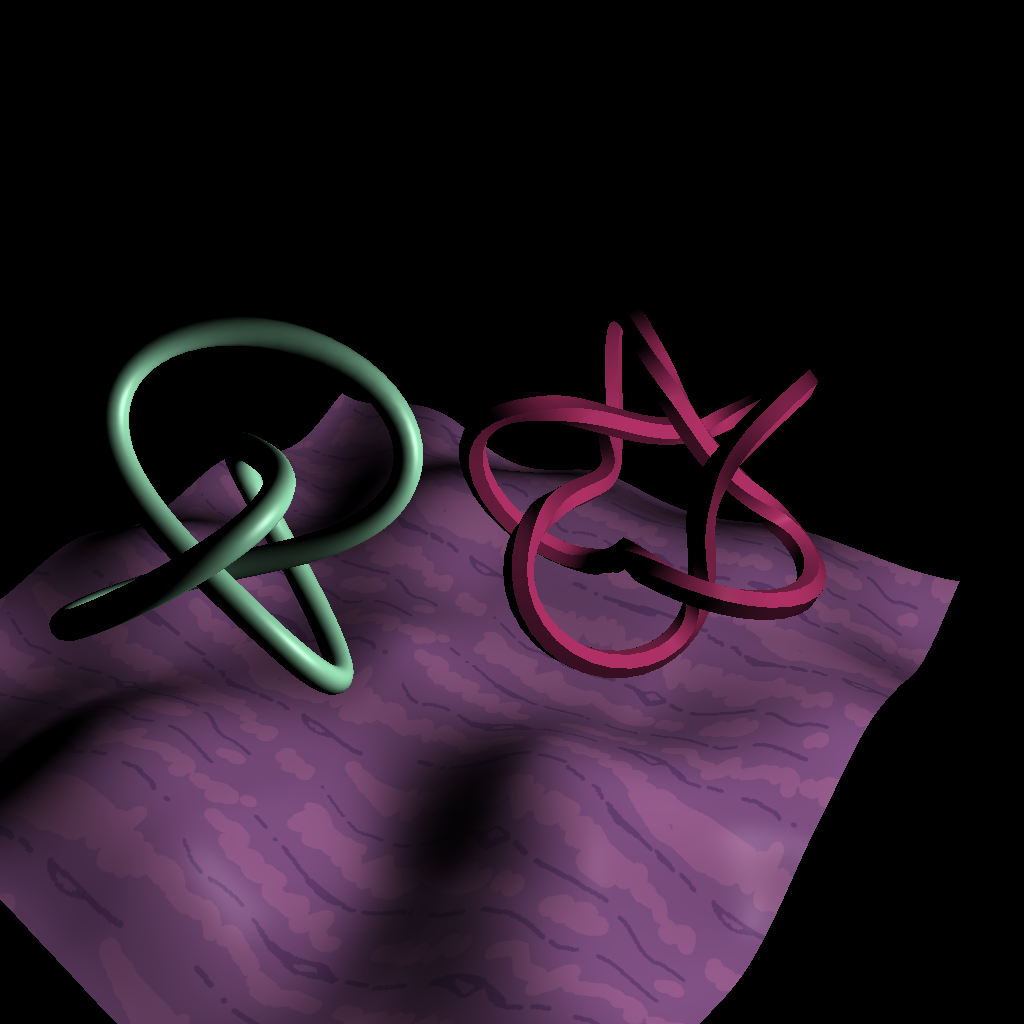
bef01af5
produces the following image:
Vertex pulling
| commit | love-demo @ 12d2f8ff |
While authoring the previous commits I decided that the Love2D's Mesh is an awkward and "quirky" API design, and that I should find a way to avoid using it entirely.
My primary complaint
is in the Mesh's inflexibility in allowing for specification of arbitrary
per-draw index buffer offsets and vertex buffer offsets, as
in glDrawElementsBaseVertex
or IASetIndexBuffer/IASetVertexBuffers.
However, there are no other APIs that Love2D exposes that allow one to define and upload vertex attributes.
Fortunately, it is possible to avoid using vertex attributes entirely via the new APIs introduced in Love2D 12.0:
love.graphics.newBufferto create Shader Storage Buffers- a new overload for
Shader:sendto bind Shader Storage Buffers love.graphics.drawFromShader(the only way to initiate indexed rendering with no Mesh object)
This "vertex pulling" approach allows me to specify whatever offset arithmetic I desire via a combination of arbitrary vertex shader code and arbitrary uniforms.
12d2f8ff
is graphically identical to the previous commit, albeit with all former uses
of Mesh entirely removed.
Scene-specified node (object) animation
| commit | love-demo @ 12d2f8ff..e5148ac4 |
A prelude to vertex skinning ("armatures"), I next implemented support for Collada -scene-specified animations. These are internally expressed as a sequence of cubic bezier curves, a parametric system of equations defined by four "control points".
Because I have chronically not given myself enough time to understand and implement De Casteljau's algorithm (or one of the myriad fancier cubic equation solving algorithms), I instead solve Bezier equations using a naive binary search. This appears to be very much sufficiently performant, even when evaluated by luajit.
e5148ac4
produces the following image, which also demonstrates bezier tangent -smoothed
transitions between a relatively small number of keyframes (~5).
Skinned vertex animation
| commit | love-demo @ e5148ac4..8d8c87c5 |
This was (intentionally) a relatively simple change to implement on top of
the previous animation code. The primary change is the introduction
of skinned_vertex.glsl.
This uses a
new VertexJWLayout Shader
Storage Buffer containing per-vertex joint indices and joint weights,
applies a weighted influences on each vertex from the Joints
uniform. Joints is an array of transformation matrices, one
transform per joint in the skeleton.
Referencing joint weights and joint indices from a shader storage buffer rather than vertex attributes also continues the pattern of deliberately avoiding the Mesh API.
8d8c87c5
produces the following image:
Shadow mapping
| commit | love-demo @ 8d8c87c5..ba777fbf |
I then decided I wanted to experiment with fancier rendering pipelines, using
multiple framebuffers and render targets. Both can be configured
via love.graphics.setCanvas
(and this is one of the few Love2D graphics APIs that this project uses that is
not Love2D 12.0 -specific).
The shadow effect is achieved by first drawing the scene from the perspective
of the light source
(collada_scene.lua:267-275),
where
the output
from this render is stored in g_shadow_canvas rather than the
window/display framebuffer.
The same scene is then redrawn
(collada_scene.lua:277-293),
but with vertex positions instead being transformed by the camera's
transformation matrix. g_shadow_canvas is sampled by in
the Shadow
function in the pixel shader. PixelLightPosition is the current
pixel's coordinates in the light coordinate space (multiplied by the same light
transformation matrix used in the previous rendering step in the vertex
shader). Pixels that have a light-coordinate-space depth value that is larger
than the depth value as sampled from g_shadow_canvas are drawn with
reduced intensity.
Note that the animation of both the light source and the camera are interpreted directly from animation data as defined in the Collada scene description as exported from a 3D modeling tool.
ba777fbf
produces the following image:
Screen Space Ambient Occlusion
| commit | love-demo @ ba777fbf..761a0073 |
This range of commits includes the first that used multiple render
targets. love.graphics.clear
has a peculiar and undocumented/underspecified behavior in that it does not
clear all attached render targets.
After experimenting with love.graphics.clear's multiple render
target variant, I decided to deliberately avoid
using love.graphics.clear and instead implement my own clear
function
via pixel_clear.glsl. As
I documented in a previous blog, there is a
negligible or zero performance difference between my pixel_clear implementation
and glClear as implemented in Mesa, as both result in either nearly
or exactly the same commands being sent to the graphics unit, depending on the
type of clear.
Avoiding double-clearing is also one of the primary reasons I also replaced love.run in a later commit.
The rendering pipeline
in 761a0073
is:
- render to the color, position, and normal "geometry" buffers
- evaluate an SSAO kernel (sampling from the color/position/normal buffers), rendering the result to an "occlusion" buffer
- blur the occlusion buffer (removes noise introduce by the noise texture from the previous step)
- blend the occlusion buffer with the color buffer, rendering to the display buffer
In pixel_ssao.glsl, I evaluate kernel_depth twice per pixel. The goal of this is to simultaneously produce highlight and shadow effects, each with independently-tuneable parameters.
761a0073
also allows SSAO constants to be interactively tuned via the q/w/a/s/z/x and
arrow keyboard keys.
A variant
of 761a0073
produced the following image:
Voxel world rendering
| commit | love-demo @ 761a0073..3b4604c6 |
Though it was previously intended that I act as the team's primary 3D environment artist (and I originally had plans that involved environments exported via Collada scenes), it was around this time that I suddenly realized that there was absolutely no way that I could satisfactorily fulfill my "3D environment artist" role and the "3D engine developer" role simultaneously within the tiny game jam period.
In part for this reason, and mostly because Shiroiii is a better environment designer than me in any case, it was decided that we'd pivot the entire project to use an environment drawn in and exported from Minecraft Beta 1.7.3 (Shiroiii's preferred 3D environment drawing tool).
Most of the work done for parsing and transforming
Minecraft MCRegion
data is done as a pre-processing step,
in mc.py. mc.py
has several responsibilities:
- I did not plan to support voxel editing whatsoever,
so
mc.pycompletely ignores/removes all blocks that are "permanently occluded" due to having 6 non-air-block neighbors. - The blocks that were not culled are then converted to naive index and vertex buffers, which are then trivially rendered.
When the camera is submerged below the "surface" of the world, the effect of
the culling step becomes obvious: most of the "permanently occluded" blocks that
would otherwise exist between bedrock and the surface no longer exist, due to
being culled by mc.py.
Despite this, this approach is still not fast enough, and the demo footage shows this--my humble development laptop indeed draws this commit at about 10-20fps for a world that was originally 1024x128x1024 voxels.
3b4604c6
produces the following image:
Faster voxel world rendering: geometry shaders
| commit | love-demo2 @ d8443b3c..86890e2a |
The most obvious next step
after 3b4604c6
is, in addition to culling entire voxels, to also cull the individual cube faces
of each voxel based on whether that voxel face has an adjacent non-air
block.
There are several ways to implement this from a data modeling and rendering perspective, but the scheme that felt most interesting to me was to generate each of the possible 63 cube face occlusion cases in a geometry shader.
Love2D (including 12.0) does not provide a geometry shader API whatsoever.
Despite this missing feature, I refused to become discouraged. I thought this geometry shader idea was too cool to ignore, so I pitched to my team: "What if we completely subvert the entire Love2D rendering API, and call OpenGL directly from C code loaded via the luajit ffi?".
To my complete surprise, the team agreed to my proposal.
Recognizing this was a radical change in approach from the previous code, I decided to start a completely new repository, which I imaginatively named love-demo2. In the first commit, I wrote a "reference implementation" for voxel world rendering that does not use a geometry shader, so that I had a baseline to use to compare performance.
In the following commit, geometry shader is as cool as I hoped it would be. The most important part of the code is this:
int conf = gs_in[0].Configuration;
if ((conf & 1) != 0) emit_face(vec3(-1.0, 0.0, 0.0), face_1);
if ((conf & 2) != 0) emit_face(vec3(0.0, -1.0, 0.0), face_2);
if ((conf & 4) != 0) emit_face(vec3(0.0, 0.0, -1.0), face_4);
if ((conf & 8) != 0) emit_face(vec3(0.0, 0.0, 1.0), face_8);
if ((conf & 16) != 0) emit_face(vec3(0.0, 1.0, 0.0), face_16);
if ((conf & 32) != 0) emit_face(vec3(1.0, 0.0, 0.0), face_32);
Configuration is a 6-bit integer bit-field (one bit per cube
face), where a bit being set represents "this face is not occluded, and should
be drawn". The emit_face function then emits triangles for the face
represented by each cube configuration bit.
The configuration bitfields themselves were generated by a fairly-heavily-rewritten mc.py.
Everything about this seemed great. The only issue was that I also bothered
to measure performance, and I determined on all of my hardware configurations
that sending cube face occlusion data as a pre-calculated list of triangles is
about 30% faster than sending cube face occlusion data as a list
of Configuration bitfields with geometry shader -generated
triangles.
It appears the primary source of anti-fun is in the OpenGL specification itself, where geometry shaders are not allowed to reorder primitives. Because the output of each geometry shader is variable length and not known at the beginning of the instance draw, the implementation must buffer the result of all instanced draws before sending the result to the next stage in the rendering pipline (a pipeline stall).
With a few hundred thousand cube instances, the impact of this stall is significant enough to have a noticable (30%) impact on performance. Faced with the harsh reality of performance-testing data, I unceremoniously discarded the geometry shader approach starting in the next commit.
86890e2a
is graphically identical to the three previous commits, the only difference
between each being changes in relative performance/framerate.
Smaller voxel world rendering: grouping cube configurations by configuration
| commit | love-demo2 @ 094847ca |
The "performance baseline"
commit d8443b3c
is quite fast, and runs at 60fps on my humble development laptop. The issue with
this commit is that it also required a 760MB blob of vertex attributes (not
committed in the git repository) to represent all of the triangles in each
world, which even after compression (and two worlds) would have meant that the
Bibliotheca technical demo would have been a ~500MB download.
Feeling this was completely unacceptable, I designed a new approach: group each cube by "configuration", and "batch" instanced cube rendering by configuration, where each instanced draw call starts drawing triangles from differing offsets in the index buffer.
This "instanced rendering, where each render uses both a unique index buffer offset and unique index count" scheme is awkward if not completely impossible to achive with the Love2D Mesh API (one Mesh object per permutation? meh.).
Compared
to d8443b3c's
"~760MB per
world", 094847ca
only requires ~16MB to represent each world, and has similar/identical
performance characteristics.
094847ca
is graphically identical to the three previous commits.
Non-cube meshes
| commit | love-demo2 @ 094847ca..50188813 |
Most of this series of commits is about data modeling for "block IDs" that use non-cube meshes (and actually 3D modeling the non-cube meshes, even if trivial).
This also introduces deferred shading, which is used for real-time point lighting for each of the torches in the scene (this is not at all the the same lighting technique that Minecraft uses).
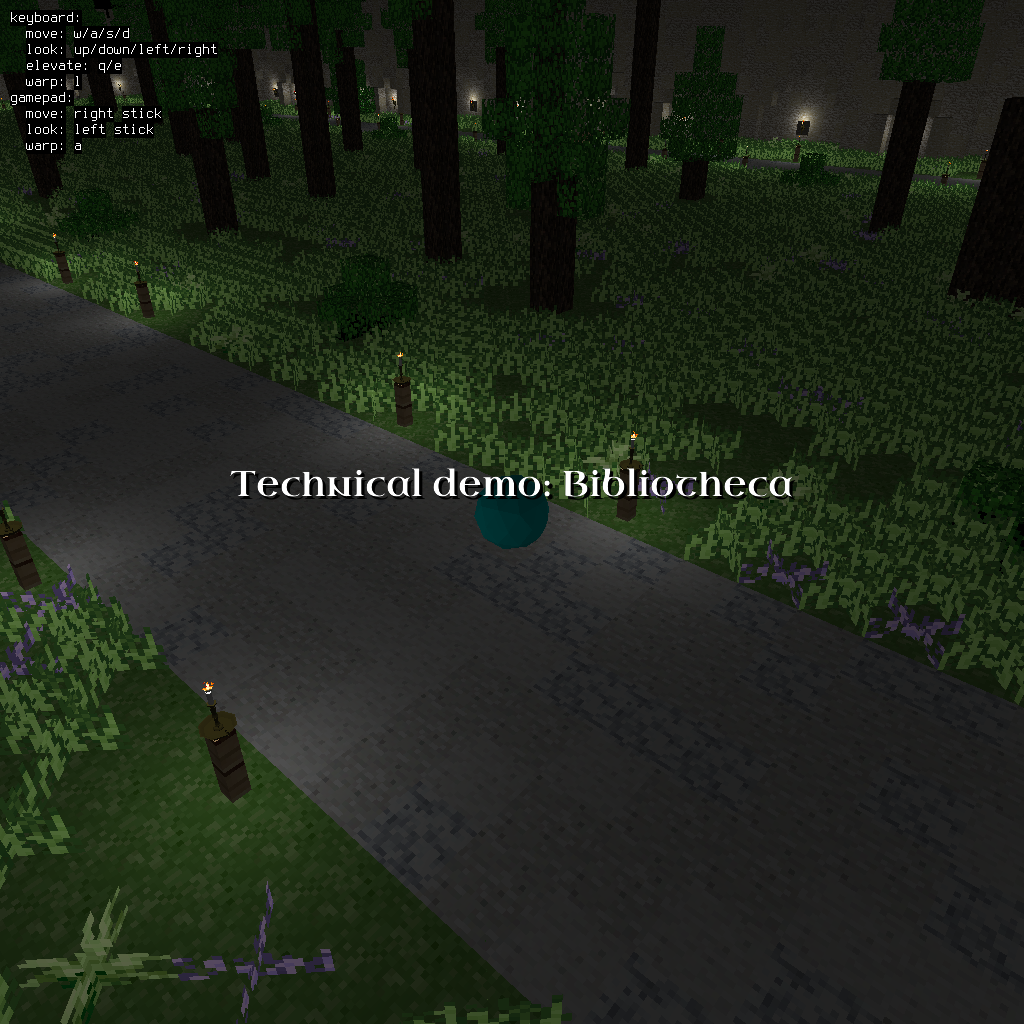
50188813
produces the following image:
Integer line-traced mouse picking
| commit | love-demo2 @ 91d86a4f |
My primary goal for this was to implement "traditional" mouse → voxel picking. However, rather than implement "real" raycasting, I thought it would be an interesting experiment to instead sample the world via by "integer line tracing" using Bresenham's line algorithm.
Its application as a replacement for raycast mouse-picking turned out to be less accurate than I hoped, but I do think the "3d line drawing" I implemented for debugging looks interesting.
The following commits do not use any of this "integer line tracing" code, and instead implement mouse picking by sampling the same geometry buffer that is already being generated for deferred shading--a pixel-exact and relatively inexpensive mouse picking implementation.
91d86a4f
produces the following image (use the left and right gamepad bumpers to draw
lines):
Voxel collision
| commit | love-demo2 @ f6bd9182..e08c74e0 |
Originally intended to be part of the mouse picking
implementation, 48a85671
also introduced "perfect hashing" for voxel worlds. Specifically, the position
(x/y/z) coordinates of all non-culled voxels are packed as 32-bit integers, then
fed to a perfect
hashing function -generating algorithm. The intent is to allow
for O(1) "does block x/y/z exist" checks without storing the voxels
in memory as a 3D array, nor resorting to a less efficient generalized hash
table.
Because I have several hundred thousand distinct voxel coordinates/keys that I want to hash, finding a suitable perfect hash function generator that wasn't either ridiculously bloated or too naive to deal with hundreds of thousands of keys was somewhat of a challenge.
Eventually I found nbperf, which is derived from NetBSD code (already a good sign), but modified to support integer keys. This was precisely what I was looking for.
The collision implementation itself is a combination of coarse bounding boxes and sphere → axis aligned bounding box collision testing, with sliding sphere collision response.
e08c74e0
collision features are identical to those demonstrated in the itch.io
release.
Bonus video: animated book
| commit | love-demo2 @ 2b379aa2 |
Download
Leave a comment
Log in with itch.io to leave a comment.